
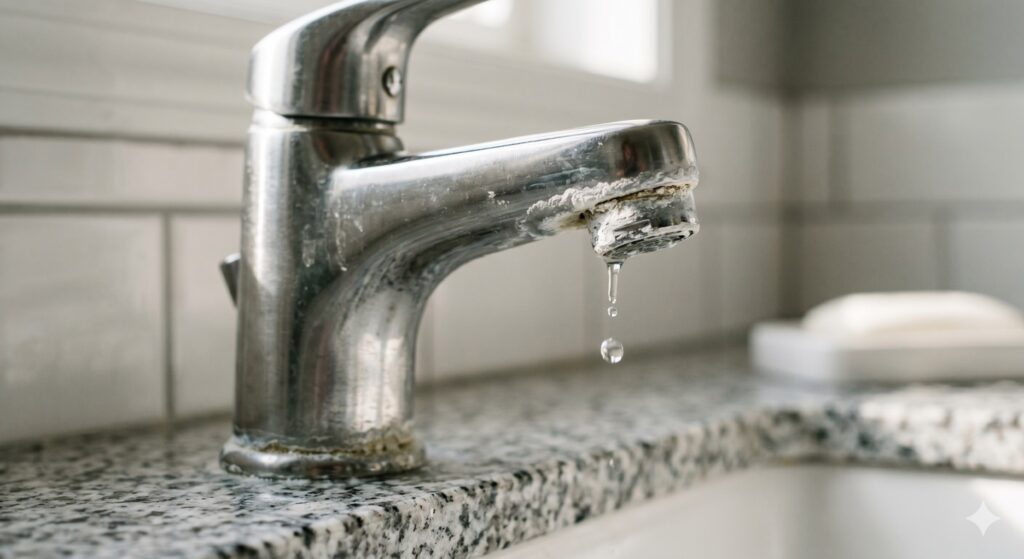
If your dishes come out of the dishwasher dotted with white film, your shower glass looks permanently foggy, and your soap refuses to lather, you’re not imagining things. Municipal water in Grand Rapids regularly tests around 9 grains per gallon of hardness, and well water across Kent County often runs higher. That puts most West Michigan homes squarely in “hard water” territory, and it’s the reason water softener installation comes up so often in local plumbing conversations.
Hard water won’t make you sick, but it works against your plumbing, your appliances, and your daily routines in ways that add up over time. The question worth answering is whether the symptoms you’re seeing actually warrant a softener, or whether something else is going on.
Key Takeaways
- Grand Rapids municipal water averages 8 to 13 grains per gallon, which is classified as hard to very hard.
- Common hard water signs include limescale on fixtures, spotted glassware, soap that won’t lather, stiff laundry, and dry skin.
- Salt-based ion exchange softeners remove calcium and magnesium by swapping them for sodium ions on resin beads.
- Proper sizing depends on your household’s daily water usage multiplied by your home’s measured hardness in grains per gallon.
- Homes on private wells, homes with iron in the water, and homes with three or more occupants typically benefit most from a softener.
What “Hard Water” Actually Means in West Michigan
Water hardness is a measure of dissolved calcium and magnesium. As water moves through limestone, dolomite, and mineral-rich soil, it picks up these ions and carries them into your home. The more minerals dissolved, the harder the water.
Hardness is measured in grains per gallon (gpg) or parts per million (ppm). One grain per gallon equals roughly 17.1 ppm. The general scale looks like this:
- Soft: 0 to 1 gpg
- Slightly hard: 1 to 3.5 gpg
- Moderately hard: 3.5 to 7 gpg
- Hard: 7 to 10.5 gpg
- Very hard: 10.5+ gpg
The City of Grand Rapids draws its water from Lake Michigan, and the most recent published water analysis put total hardness at around 9.4 gpg, with readings ranging from 8 to 13 across the distribution system. That qualifies as hard, sometimes very hard depending on where you live in the network.
Homes on private wells across Kent, Ottawa, and Allegan counties tend to see even higher readings. Well water also frequently carries iron, which a standard softener can address up to a point but a water softener and dedicated filtration system handle more reliably together.
7 Hard Water Signs Most Grand Rapids Homeowners Recognize
You don’t need a lab test to suspect hard water. The symptoms are consistent, and most homeowners notice at least three or four of them once they know what to look for.
1. White or chalky residue on fixtures and glassware. That crust around faucet aerators and the cloudy film on dishes is limescale, calcium carbonate left behind when water evaporates.
2. Soap that won’t lather. Hard water minerals react with soap to form soap scum instead of suds. You end up using more shampoo, more dish detergent, and more laundry pods to get the same result.
3. Stiff, dingy laundry. Mineral deposits get trapped in fabric fibers, leaving towels rough and whites looking gray over time.
4. Dry skin and dull hair. The same soap-scum reaction happens in the shower. A film coats your skin and hair, leaving both feeling tight, itchy, or lifeless even after a long rinse.
5. Slow or reduced water pressure. Scale narrows the inside of supply lines and fixture cartridges, restricting flow. If pressure has dropped gradually over years, hard water is a likely culprit.
6. Shorter appliance lifespan. Dishwashers, washing machines, ice makers, coffee makers, and especially water heaters wear out faster when scale coats their heating elements and internal passages.
7. Frequent water heater issues. Sediment buildup at the bottom of a tank water heater is largely limescale. It insulates the burner from the water, drives up energy use, and accelerates wear on the anode rod.
If three or more of these apply to your home, you almost certainly have hard water working against you.
How a Water Softener Works (Without the Chemistry Lecture)
A traditional water softener uses a process called ion exchange. Here’s the short version:
Inside the softener tank sit thousands of small resin beads, each coated in sodium ions. When hard water flows through the tank, the calcium and magnesium ions are more strongly attracted to the resin than the sodium is. They swap places. Calcium and magnesium stick to the beads. Sodium releases into the water and flows out to your fixtures.
Eventually the resin runs out of sodium and fills up with calcium and magnesium. That’s when regeneration happens. The system pulls a strong brine solution from the salt tank, rinses it through the resin, and reverses the exchange. The calcium and magnesium flush down a drain line, sodium recoats the beads, and the cycle starts over. Most modern softeners regenerate every few days based on either a timer or a meter that tracks actual water usage.
Salt-free systems work differently. They use template-assisted crystallization or similar technology to alter how minerals behave so they don’t stick to surfaces, but they don’t actually remove the minerals. They reduce scale, but they don’t deliver the full slippery-soft-water experience of a true softener. For most West Michigan households dealing with 9+ gpg water, salt-based remains the more effective choice.

What Water Softener Installation Looks Like in a Real Home
A professional water softener installation typically involves a few key steps that vary based on your home’s layout and existing plumbing.
The unit needs to sit on the main water line, after the shutoff and pressure regulator but before the water heater. Most installs happen in a basement, utility room, or garage near where the main line enters the home. The plumber cuts into the supply line, installs a bypass valve, and connects the inlet and outlet to the softener.
The system also needs a drain line for regeneration discharge, usually routed to a floor drain, utility sink, or standpipe. A standard 120-volt outlet powers the control head. The brine tank, which holds the salt, sits next to the resin tank.
A clean install in a straightforward basement takes a few hours. Older homes with copper or galvanized supply lines, tight mechanical rooms, or no nearby drain can complicate the job. This is where DIY attempts often go sideways. Improper connections cause leaks, undersized bypass loops restrict flow, and missing air gaps on the drain line create code violations and contamination risk. A licensed plumber sizes the unit correctly, runs the connections to code, and pressure-tests everything before walking away.
While the system is being installed, it’s a good moment to address related issues. A plumbing inspection can identify scale damage already underway in supply lines and fixtures, and homes with persistent staining or odor concerns often benefit from pairing a softener with whole-home water filtration to handle iron, sediment, and chlorine taste.
Sizing a Softener for Your Household
Sizing matters more than most homeowners realize. An undersized softener regenerates too often, burns through salt, and can’t keep up during peak demand. An oversized one sits idle between cycles, which can lead to resin fouling and reduced efficiency over time.
The basic formula:
Daily water usage (gallons) × Hardness (gpg) = Daily grains of hardness to remove
The average person uses about 75 gallons per day. For a family of four, that’s 300 gallons. At Grand Rapids’s typical 9 gpg, the daily load is 300 × 9 = 2,700 grains. Multiply by the days between regenerations (most systems target 3 to 7), and you arrive at the minimum grain capacity. A family of four on city water generally lands in the 32,000- to 40,000-grain range. Well water with added iron pushes the requirement higher, since each ppm of iron counts as roughly 4 to 5 additional grains of hardness for sizing purposes.

Do You Actually Need One? A Decision Framework
Not every home in West Michigan needs a softener, and there’s no single threshold that triggers an automatic yes. The decision depends on the combination of your water source, your hardness reading, your household, and what’s currently failing.
| Situation | Softener Recommendation |
|---|---|
| City water, hardness under 7 gpg, no visible symptoms | Likely not needed |
| City water, hardness 7 to 10 gpg, mild fixture scale | Helpful but optional |
| City water, hardness 10+ gpg, multiple symptoms | Strongly recommended |
| Private well, any hardness reading | Almost always recommended |
| Well water with iron above 0.3 ppm | Softener plus iron filtration |
| Recurring water heater failure or pipe scaling | Strongly recommended regardless of source |
| Household of 4+, hardness 8+ gpg | Strongly recommended |
A few other factors weigh into the call. If your home has older copper or galvanized supply lines, scale accelerates the path to corroded pipes and pinhole leaks. If anyone in the household has skin sensitivity, eczema, or hair texture issues, softened water makes a noticeable daily difference. And if you’ve already replaced a water heater earlier than expected, adding a softener and learning how to flush your water heater annually can protect the next one.
For homes that fall in the “maybe” zone, a free professional water test is the cleanest way to settle the question. It confirms your actual hardness reading, identifies any secondary concerns like iron or pH, and gives a plumber the data needed to recommend a properly sized solution rather than a one-size-fits-all package.
Frequently Asked Questions
Is Grand Rapids water hard enough to require a softener?
Most of the city’s distribution system tests between 8 and 13 grains per gallon, which is hard to very hard. Whether a softener is necessary depends on which symptoms you’re seeing and which appliances you want to protect. Homes consistently above 10 gpg with visible scale almost always benefit.
Will a water softener make my water taste salty?
No. Ion exchange adds a small amount of sodium based on the hardness level being removed, but the amount is well below what most people can taste. A glass of softened water typically contains less sodium than a slice of bread. If sodium intake is a medical concern, a potassium chloride substitute or a reverse osmosis tap at the kitchen sink solves that.
How long does a water softener last?
A properly sized and maintained salt-based softener typically lasts 10 to 15 years. Resin can last longer with clean water, and shorter if iron or chlorine attacks it without pre-filtration. The control head is usually the first component to need service.
Do I need a softener if I’m on city water?
Lake Michigan-sourced municipal water is treated for safety, but treatment doesn’t remove hardness minerals. City water in Grand Rapids is still hard. If you’re seeing scale, soap-scum, or appliance issues, a softener helps even with city water.
Can I install a water softener myself?
Technically possible, but the install involves cutting into your main water line, soldering or compression-fitting new connections, running a drain line with a proper air gap, and tying into an electrical outlet. Mistakes cause leaks, code violations, and warranty problems. Professional installation protects the equipment warranty and your home.
What’s the difference between a water softener and a water filter?
A softener removes calcium and magnesium to address hardness. A whole-home filter removes sediment, chlorine, iron, sulfur, or other contaminants depending on the media. Many West Michigan homes, especially on wells, benefit from both working together.
How much salt does a water softener use?
A typical family of four in Grand Rapids goes through roughly 40 to 80 pounds of salt per month, depending on hardness, system size, and regeneration efficiency. Demand-initiated systems use less salt than timer-based systems because they only regenerate when needed.
Contact Grapids Home Services for a Local Water Assessment
If your home is showing signs of hard water and you want a clear answer instead of a guess, a licensed plumber can test your water, walk you through the sizing math, and recommend a system that fits your household. Call (616) 210-3456 or contact us online to schedule a water softener consultation in Grand Rapids or the surrounding West Michigan area.
About Grapids Home Services
Since 1999, Grapids Home Services has provided HVAC and plumbing services to homeowners throughout Grand Rapids and Kent County. Our licensed, background-checked plumbers handle water softener installation, water heater service, leak detection, and whole-home plumbing repairs across West Michigan. We focus on accurate diagnosis, clean installs, and getting the sizing right the first time.