
If your heating bills feel too high for what you’re getting, a home energy audit can show you exactly where your Grand Rapids home is losing money. Many older houses here are under-insulated and full of air leaks that drive up costs every winter.
Our BPI-certified auditors have been helping homeowners in the area find and fix those problems since 1999, and our team knows what to look for in houses built before modern energy codes existed. Stop guessing where your heat is going. Get a real answer from a local expert.
Key Takeaways
- A home energy audit identifies air leaks, insulation gaps, and equipment inefficiencies that raise your monthly bills.
- Grand Rapids winters average around 136 heating days per year, making thermal performance a real financial issue for local homeowners.
- Many pre-1980 homes in Grand Rapids have attic insulation well below Michigan’s current R-49 code requirement.
- Audit findings may qualify you for federal tax credits or Consumers Energy rebates that offset upgrade costs.
- Most homeowners see a clear payback on audit-recommended improvements within a few heating seasons.
If your heating bills spike every January and February, you’re not alone. Older houses in Eastown, Alger Heights, and Fulton Heights are some of the worst offenders. Thin walls, uninsulated attics, and leaky ductwork that have never been touched since the Carter administration bleed heat all winter long.
A home energy assessment in Grand Rapids is the smartest first step before you spend a dollar on upgrades. It tells you exactly where heat is escaping, how bad the problem is, and what fixes will actually move the needle on your bills. You’ll often hear the words “assessment” and “audit” used interchangeably, but they aren’t always the same thing: a free utility assessment is usually a visual walkthrough, while a full audit adds calibrated equipment testing that measures your actual leakage and equipment performance.
This article walks you through what auditors actually do inside your house, what it costs locally, how the 2026 federal tax credit works, and whether the findings are worth acting on. If you’ve been guessing at the problem, this guide gives you a real answer.
What Happens During a Home Energy Audit?

A certified auditor comes to your house and runs a series of diagnostic tests to find exactly where energy is escaping. It is not a visual walkthrough or a checklist of guesses. The auditor uses calibrated equipment to measure real air leakage, locate missing insulation, and assess your HVAC system against 12 months of your utility bills.
Here is what a full audit covers:
- Blower door air leakage test
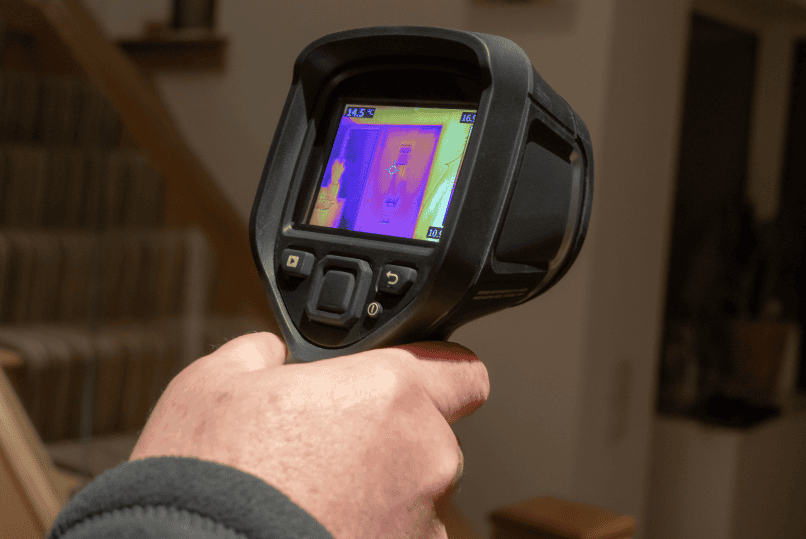
- Infrared thermal scanning of walls, ceilings, and floors
- Duct leakage testing with a duct blaster fan
- HVAC system age, efficiency rating, and condition check
- Attic insulation depth measurement
- Utility bill baseline review
The Blower Door Test
The blower door test is the centerpiece of any home energy audit. The auditor mounts a calibrated fan in an exterior doorframe and depressurizes your house to 50 Pascals. The fan measures air leakage in CFM50, which tells you exactly how tight or leaky your thermal envelope is.
Well-sealed homes built after 2000 in areas like Walker or Wayland typically test below 5 ACH50. Older houses in neighborhoods like Creston or Heritage Hill routinely hit 10 to 15 ACH50 or higher. While the fan runs, the auditor uses a smoke pencil or infrared camera to pinpoint exactly where air is escaping. Rim joists, recessed lights, attic hatches, and old window frames are the most common culprits in this region’s older housing stock.
Infrared Thermal Scanning and Duct Leakage Testing
Infrared thermal scanning shows temperature differentials on your walls and ceilings. Cold spots reveal missing insulation, thermal bridging through studs, or moisture intrusion you cannot see with the naked eye. This is how auditors find attics running well below the R-49 the Michigan Energy Code requires for new construction.
Duct leakage testing uses a duct blaster fan attached to your supply or return plenum. BPI data shows the average home loses 20 to 30 percent of conditioned air through duct leaks. Where furnaces run six or more months a year, that loss adds up fast. Thinking about HVAC efficiency in your Grand Rapids home starts with knowing whether your ducts are actually delivering conditioned air where it needs to go.
HVAC System and Insulation Assessment
The auditor reviews your furnace, air conditioner, and water heater. They note equipment age, efficiency ratings, and ductwork condition. If you are unsure whether your current setup makes sense for your house’s size, this is a good time to think about choosing the right HVAC system for your Grand Rapids home before making any upgrades.
Attic insulation depth gets measured directly. Many pre-1980 houses locally have R-19 or less, roughly the amount many attics were built with decades ago, and far short of the R-49 current code calls for. The auditor also pulls 12 months of utility bills to establish a baseline energy profile, so every recommendation is tied to real numbers from your household.
How Much Does a Home Energy Audit Cost in Grand Rapids?

The price depends on how thorough the assessment is. A basic visual walkthrough with a utility bill review runs $150 to $250. A full audit with blower door testing, duct leakage testing, and infrared scanning costs $350 to $600 for a home in the 1,500 to 2,500 square foot range. Most homeowners land somewhere in that middle range.
Typical Audit Price Ranges Locally
Here’s a quick breakdown of what you get at each price point:
- $150 to $250: Visual inspection, utility bill review, basic recommendations. No equipment testing.
- $350 to $600: BPI-certified audit with blower door test, duct leakage measurement, and infrared thermal scanning. Written report included.
- Free or subsidized: Consumers Energy has historically offered low-cost residential energy assessments for qualifying customers. Verify current program availability on the Consumers Energy residential programs page before paying full price.
To put that cost in perspective: natural gas bills in the Walker and Wyoming areas commonly run $200 to $400 per month in January and February. A 15 percent efficiency improvement pays back a $400 audit in a single heating season.
The 2026 Federal Tax Credit for Home Energy Audits
The IRS Section 25C credit lets you claim up to $150 back on a qualified home energy audit. To qualify, a certified auditor must conduct the assessment and provide a written report with recommended improvements and estimated savings. The Energy Star federal tax credit page has the official requirements.
That $150 is separate from the larger credits available for upgrades like heat pumps, insulation, and efficient water heaters. Getting the audit done first gives you a clear roadmap so you can claim every credit you’re entitled to. The audit pays for itself twice: once in energy savings, once at tax time.
See if your home qualifies for a Consumers Energy rebate. Book your audit and get a written report you can act on.
What Do Auditors Find Most Often in Grand Rapids Homes?
If your house was built before 1980, there’s a good chance an auditor will find the same handful of problems. Homes in Midtown and on the West Side are especially common candidates. These neighborhoods have large stocks of 1920s and 1950s construction with minimal wall insulation, no vapor barriers, and air leaks that have been losing heat for decades.
Here are the five findings that show up most often in a home energy efficiency assessment across the region:
- Air leaks at rim joists and band boards
- Attic insulation well below current Michigan Energy Code
- Duct leakage into unconditioned attics or crawlspaces
- Aging furnace or boiler running below rated efficiency
- Outdated or manual thermostat
Air Sealing and Insulation Gaps in Older Michigan Homes
The rim joist is the band of wood that sits between your foundation wall and the first floor framing. In older Michigan houses, it is almost never insulated. Cold air pours through it all winter. Auditors flag this in the majority of pre-1980 homes they inspect.
Attic insulation is the other big one. Bypasses around recessed lights and top plates make thin insulation worse. Warm air funnels straight into the attic while your furnace keeps running to compensate, so sealing those bypasses before you add insulation is critical.
Aging or Oversized HVAC Equipment
If your furnace or boiler is 15 to 20-plus years old, an auditor will look hard at it. Older equipment often runs well below its original rated efficiency. That’s money leaving the house every heating cycle, and Michigan’s heating season runs roughly October through April, so those losses add up fast.
Oversized equipment is just as costly. A furnace that’s too big short-cycles. It blasts heat, shuts off, blasts heat again. It never runs a full, efficient cycle. You can read more about how long HVAC systems last in Grand Rapids homes to get a sense of where your equipment stands.
Duct Leakage and Thermostat Inefficiency
Duct systems in older houses often run through unconditioned attics and crawlspaces with joints that have never been sealed. Conditioned air leaks out before it reaches your living space. An HVAC energy audit locally will almost always include a duct leakage test for this reason.
Thermostats are a quick fix with real payoff. A smart thermostat that learns your household schedule can cut heating and cooling costs by 10 to 15 percent with no other changes. Our team recommends reviewing your spring HVAC maintenance checklist after your audit to make sure your system is ready to run efficiently once upgrades are in place.
Is a Home Energy Audit Actually Worth It for Grand Rapids Homeowners?
Yes, for most homeowners in this region, a home energy audit pays for itself. The honest answer is that it depends on your house’s age, condition, and your current utility bills. Here’s how to think through it.
Natural gas bills in the area can run $200 to $400 per month in January and February. A 15 percent reduction in heating costs can recover a $400 audit fee in a single winter. The $150 federal tax credit brings your net cost down to as little as $50 to $250, which makes the math much easier.
When an Audit Pays for Itself Quickly
A home energy assessment in the Walker, Wyoming, or Sparta areas tends to deliver the strongest return when one or more of these apply:
- Your heating or cooling bills have climbed year over year with no clear reason
- Certain rooms stay too cold or too hot regardless of thermostat settings
- Your house was built before 1985 and has never been assessed
- You are planning a major upgrade and need to right-size the equipment
- You are buying or selling a home and want to know what you are getting into
If you are buying a house and want to know what you are walking into, pairing an audit with a review of home upgrades buyers should inspect before closing is a smart combination.
When You Might Not Need a Full Professional Audit
If your house was built after 2010, recently reinsulated, and your bills are stable, a full blower-door audit may not surface enough findings to justify the cost. In that case, start with a free online home energy assessment through Consumers Energy. It is a reasonable first step for newer, well-maintained homes in Zeeland or Wayland before committing to a paid audit.
Not sure if your home needs a full audit? Our team can help you figure out the right starting point. Call us at (616) 210-3456 to talk it through.
What to Do After Your Energy Audit: Prioritizing the Upgrades
You have the audit report in hand. Now what? The key is working through the findings in order of impact, not just tackling whatever feels easiest. Here’s how to think about it.
High-Impact, Lower-Cost Fixes to Do First
Start with air sealing. Caulk around window frames, door trim, and any penetrations where pipes or wires enter your home. Add weatherstripping to exterior doors. These are weekend projects most homeowners in Walker, Wyoming, and Wayland can handle themselves.
After air sealing, look at your attic. Many pre-1980 homes in the area sit at R-19 or less. Getting to R-49 is one of the most cost-effective moves you can make. Seal duct joints with mastic sealant or metal foil tape, not standard duct tape, which dries out and fails within a few years.
A smart thermostat installation rounds out this tier. Together, these four steps can cut heating and cooling costs by 20 to 30 percent. That is real money across a six-plus month heating season. For more ideas on keeping costs down, see the easiest way to save money on cooling costs.
Bigger Investments: HVAC, Insulation, and Water Heaters
Once the thermal envelope is tightened, larger equipment replacements make sense. Skipping that order is a common mistake. A new furnace sized for a leaky house will be oversized once you seal it up.
The good news is that federal tax credits make these upgrades more affordable right now:
- A high-efficiency furnace at 96 percent AFUE or higher qualifies for a 30 percent credit, up to $600.
- A heat pump water heater qualifies for a 30 percent credit, up to $2,000.
- A new heat pump system qualifies for up to $2,000.
Our team has been handling HVAC upgrades across West Michigan since 1999. If you bring us your audit report, we can walk through it with you and give a straight answer on which upgrades fit your home and your budget. No pressure, just honest guidance on what actually moves the needle.
How Grand Rapids’ Climate Makes Energy Audits More Valuable Than Average
Yes, this is one of the better places in the country to get a home energy assessment. Here’s why. Our region sits in USDA Hardiness Zone 6a, with average winter lows around 18°F and roughly 136 heating days per year. That’s a long, hard heating season. Thermal envelope performance matters more here than it does in moderate climates. Every gap in your insulation or air barrier costs you real money, month after month.
Lake Michigan makes things harder. Lake-effect snow and elevated winter humidity drive cold air into your house from multiple directions. Then summer flips the problem: that same lake influence pushes humidity levels up, which makes your air conditioning work overtime. Your building envelope takes a beating in both seasons.
A blower door test can pinpoint exactly where cold air is sneaking in during winter and where humid air is loading up your AC in summer. That’s information you can act on.
Houses in Fulton Heights, Alger Heights, and Wyoming-area neighborhoods were largely built before modern energy codes. Many have little to no wall insulation, uninsulated rim joists, and no continuous air barrier. These homes benefit most from a home energy efficiency audit because the leakage points are everywhere and invisible without testing equipment.
If your house was built before 1980, an audit is one of the smartest things you can do before another Michigan winter hits. Check out our tips on improving HVAC efficiency in your Grand Rapids home to get a head start.
Our team can walk you through the HVAC and plumbing systems an auditor is likely to flag. Reach out to us and we’ll help you make sense of your audit results.
Frequently Asked Questions
How long will the auditor be at my house?
Plan on 2 to 4 hours for most local homes in the 1,500 to 2,500 square foot range. Larger houses or homes with complex duct systems can run up to 6 hours. You need to be home the entire visit so the auditor can access the attic, basement, and mechanical systems.
Can I do this myself and still qualify for the tax credit?
A self-assessment can help you spot obvious drafts or thin attic insulation, but it cannot replace a blower door test or an infrared scan. DIY results also do not qualify for the energy audit tax credit 2026 under IRA Section 25C. You need a certified auditor and a written report to claim that credit.
What credentials should I look for when hiring an auditor?
Look for BPI Building Analyst or RESNET Home Energy Rater credentials. Before you book, ask directly whether their report qualifies for IRA Section 25C. Not every auditor’s paperwork meets the requirement, and that matters if you plan to claim the credit.
Does a home energy audit cover my water heater and plumbing?
A standard home energy audit will note if your water heater looks inefficient or outdated, but it does not inspect pipes, drains, or fixtures in detail. If the report flags your water heater, check out our guide on signs it may be time for a new water heater to decide your next step.
How soon will I see savings after making upgrades?
Air sealing and attic insulation finished before the heating season can show up in your bills within 30 to 60 days. Most local homeowners who complete the top recommendations see 15 to 30 percent reductions in annual energy costs. Larger upgrades like heat pumps deliver consistent savings for 15 to 20 years.
Is the home energy audit tax credit still available in 2026?
Yes. IRA Section 25C remains in effect in 2026 and covers up to $150 for a qualifying home energy audit conducted by a certified auditor with a written report. That is separate from larger credits available for heat pumps, insulation, and efficient water heaters.
Ready to stop guessing where your heat is going? Call Grapids Home Services at (616) 210-3456 or reach out to our team online to talk through which HVAC, plumbing, or insulation upgrades your audit report is likely to flag. Our team has been handling these systems in West Michigan since 1999 and can give you a straight answer on what makes sense for your home and budget.
Ready to Get Started with Grapids Home Services?
Call (616) 210-3456 to speak with our team directly. We’re ready to answer your questions, walk you through your options, and help you find the right solution for your needs. Whether you’re just starting to plan or ready to move forward, we’ll make the process simple and stress-free.
Reach out today and let’s talk about how we can help.