
Heat pumps have become one of the most frequently discussed home comfort options in West Michigan over the past several years, and for good reason. Energy costs, climate considerations, and significant advances in cold-climate heat pump technology have made them a realistic option for many Greater Grand Rapids homeowners who previously would have dismissed them as unsuitable for Michigan winters. But along with growing interest comes plenty of confusion about what a heat pump actually is, how it operates, and whether it can realistically handle a January cold snap in Grand Rapids.
The good news is that understanding how a heat pump works is more straightforward than most homeowners expect. The technology is not magic, but it is genuinely impressive: a heat pump can deliver two to three times more heating or cooling energy than the electricity it consumes by moving heat rather than generating it. Modern cold-climate models are rated to operate efficiently at outdoor temperatures well below zero, which puts Michigan winters well within their capable range.
This guide explains how heat pumps work, how they heat and cool your home, how they perform in West Michigan’s climate, and how they compare to the furnaces and central air conditioners that most Greater Grand Rapids homes currently use. If you have questions about heat pump installation or want to know whether a heat pump makes sense for your home, the team at Grapids Home Services is here to help.
The Basic Principle: Moving Heat Instead of Making It
The fundamental principle behind a heat pump is that it moves heat from one place to another rather than generating heat through combustion or electrical resistance. Your refrigerator works on the same principle: it moves heat from inside the cabinet to the coils on the back, keeping the interior cold while warming the kitchen slightly. A heat pump does the same thing on a much larger scale, and crucially, it can reverse the process depending on whether you need heating or cooling.
Heat pumps exploit a physical property of refrigerants: when a refrigerant changes state from liquid to gas, it absorbs heat from its surroundings; when it changes back from gas to liquid, it releases that heat. By controlling when and where those phase changes happen, a heat pump can extract heat from cold outdoor air and deliver it inside during winter, or extract heat from indoor air and release it outside during summer.
The efficiency of this process is why heat pumps are measured differently from furnaces and electric resistance heaters. Instead of efficiency percentage, heat pumps are rated by their Coefficient of Performance, or COP, which expresses how many units of heat they deliver per unit of electricity consumed. A good cold-climate heat pump can achieve a COP of 2.5 to 4 at moderate temperatures, meaning it delivers two and a half to four times more heat energy than the electrical energy it uses. No combustion-based heating system can match that ratio.
How a Heat Pump Heats Your Home in Winter
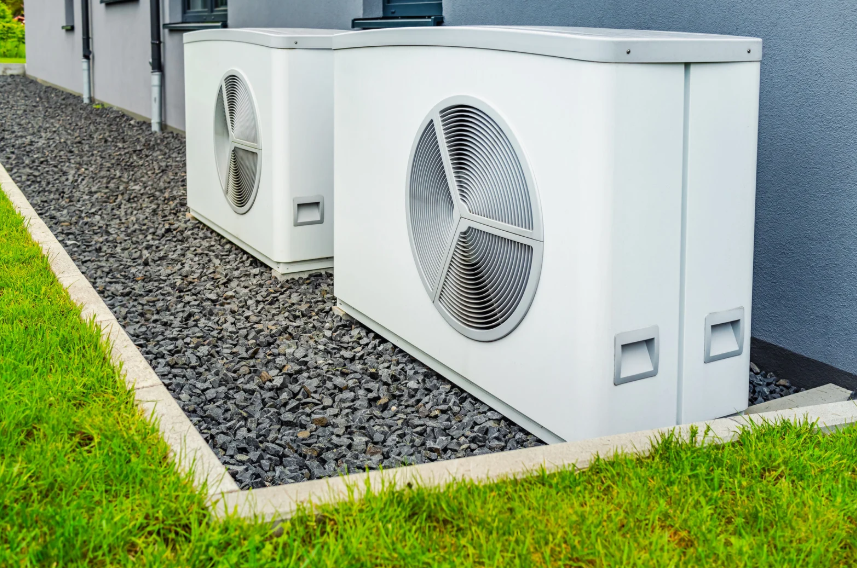
In heating mode, the heat pump’s outdoor unit contains a coil filled with refrigerant. Even when outdoor air temperatures feel cold to you, that air still contains significant heat energy. The refrigerant in the outdoor coil absorbs that heat, causing it to evaporate from liquid to gas. The compressor then pressurizes the refrigerant gas, which raises its temperature significantly, and pumps it to the indoor coil. There, the hot refrigerant releases its heat into your home’s air, which the air handler distributes through your ductwork.
After releasing its heat indoors, the refrigerant cools, condenses back to liquid, and returns to the outdoor unit to absorb more heat from the outdoor air. This cycle continues as long as the system is running in heating mode. The reversing valve is the component that allows the heat pump to switch between heating and cooling: it redirects refrigerant flow so that the indoor coil and outdoor coil swap their roles.
One common misconception is that heat pumps stop working when outdoor temperatures drop below freezing. Older heat pump technology did lose significant efficiency below about 30 degrees Fahrenheit, which made them a questionable choice for climates like West Michigan’s. Modern cold-climate heat pumps, however, are engineered to maintain effective heating capacity at temperatures as low as minus 13 to minus 22 degrees Fahrenheit, which covers virtually every realistic winter day in greater Grand Rapids. Some models include variable-speed compressors that continuously modulate their output to match the home’s heat loss, which improves both efficiency and comfort.
How a Heat Pump Cools Your Home in Summer
In cooling mode, a heat pump operates identically to a standard central air conditioner. The reversing valve switches the refrigerant flow so that the indoor coil now acts as the evaporator, absorbing heat from your home’s air and causing the refrigerant to evaporate. The outdoor unit then acts as the condenser, releasing that heat into the outdoor air. From a performance and efficiency standpoint, a heat pump in cooling mode is equivalent to a similarly rated central air conditioner.
This dual functionality is one of the primary practical advantages of a heat pump over a separate furnace and central AC setup. Instead of maintaining two separate systems with two sets of components that can fail independently, a heat pump handles both heating and cooling from a single piece of outdoor equipment paired with an air handler. This simplifies maintenance, reduces the number of components that can develop problems, and eliminates the need for a gas line if you are building new or replacing aging equipment.
In West Michigan’s increasingly humid summers, the dehumidification that occurs as a byproduct of air conditioning is just as valuable as the temperature reduction. A properly sized heat pump in cooling mode will dehumidify your home’s air as effectively as a central AC unit of the same capacity. If indoor humidity is a persistent issue in your Greater Grand Rapids home beyond what cooling alone resolves, a whole-home dehumidifier integrated with your system can complement the heat pump’s dehumidification.
Heat Pump Performance in Cold Michigan Winters
West Michigan’s climate presents a genuine test for any heating system. Lake-effect snow events can push temperatures into the single digits for extended periods in January and February, and homes that were built to rely on natural gas furnaces are accustomed to a system with essentially unlimited heating capacity regardless of how cold it gets outside. A heat pump’s heating capacity does decrease as outdoor temperatures fall, which is the legitimate concern behind the common claim that heat pumps do not work well in Michigan.
The honest answer is that the performance of a heat pump in Michigan depends heavily on which heat pump you install. Older standard heat pumps with single-stage compressors can lose 25 to 40 percent of their rated heating capacity at around 17 degrees Fahrenheit. Cold-climate models with variable-speed compressors and enhanced vapor injection technology are specifically engineered to address this: many are rated to deliver 70 to 80 percent of their nominal heating capacity at 5 degrees Fahrenheit, and some maintain meaningful output even at minus 22.
For most Greater Grand Rapids homeowners considering a heat pump, the practical approach is a dual-fuel system: a cold-climate heat pump paired with a gas furnace. The heat pump handles heating efficiently during the majority of the heating season, when temperatures are mild enough that its efficiency advantage over the furnace is significant. The furnace takes over only during the coldest days when outdoor temperatures drop below the heat pump’s balance point, typically around 5 to 15 degrees Fahrenheit depending on the model. This combination delivers the efficiency benefits of a heat pump during most of the heating season without sacrificing comfort on the coldest West Michigan nights.
Air Source vs. Ground Source Heat Pumps
The heat pumps most commonly installed in Greater Grand Rapids homes are air source heat pumps, which extract heat from outdoor air as described above. They look similar to a central AC outdoor unit and are installed in the same way, making them a practical retrofit for homes that already have ductwork and an air handler. Installation costs are generally comparable to replacing a central AC system, and the operating cost savings in West Michigan can offset that investment over several years depending on your current heating fuel and usage.
Ground source heat pumps, also called geothermal heat pumps, extract heat from the ground rather than the air. Because the ground temperature at depths of six feet or more remains relatively stable throughout the year at around 50 to 55 degrees Fahrenheit in West Michigan, a ground source heat pump operates at more consistent efficiency than an air source model, which must work harder as outdoor temperatures drop. Ground source systems are highly efficient and extremely durable, but they require drilling or trenching for the ground loop, which adds significantly to installation cost and complexity.
Mini-split heat pumps represent a third category: ductless air source systems that deliver heating and cooling directly to individual rooms or zones without requiring ductwork. Mini-split systems are particularly useful for heating and cooling additions, finished basements, workshops, and other spaces that are not served by the main duct system. They are also an efficient option for older Greater Grand Rapids homes where adding full ductwork would be prohibitively expensive.
Heat Pumps vs. Furnaces: What Makes Sense for West Michigan Homes
The comparison between a heat pump and a natural gas furnace involves several variables specific to your home and situation. Natural gas furnaces have a significant first-cost advantage in Michigan because natural gas is relatively affordable here, and a high-efficiency gas furnace installed in a home that already has gas service is a straightforward, well-understood upgrade. For homeowners replacing a failing furnace on a tight timeline with no interest in switching fuel sources, a new high-efficiency gas furnace paired with a new central AC unit remains a perfectly reasonable choice.
A cold-climate heat pump makes more financial sense in specific scenarios: homes without existing gas service where electric heat is the current alternative, homes where the AC system also needs replacement and a heat pump can replace both for the cost of one installation, homes where the owners have a strong interest in reducing carbon emissions, and homes in areas where electricity rates are favorable relative to gas. The financial calculation shifts significantly with current utility rate structures in West Michigan, so running the numbers with your actual utility bills is worthwhile before deciding.
A dual-fuel system, combining a cold-climate heat pump with a gas furnace as a backup, offers a middle path that many Greater Grand Rapids homeowners find appealing. The heat pump handles the bulk of the heating load during the milder portions of the heating season when it operates most efficiently, and the furnace provides reliable backup on the handful of days each winter when temperatures drop into the extreme cold range where the heat pump’s efficiency drops noticeably. If you are interested in exploring this option, the HVAC team at Grapids Home Services can assess your home and provide a comparison based on your current usage.
When to Call an HVAC Professional in Greater Grand Rapids
Heat pump installation, sizing, and service require specialized knowledge that goes beyond standard furnace and AC work. Proper sizing is especially critical because an undersized heat pump will struggle on cold days and an oversized one will short-cycle, reducing both comfort and efficiency. Refrigerant handling for heat pumps requires EPA Section 608 certification. And diagnosing heat pump performance issues, particularly distinguishing between a refrigerant problem, a reversing valve failure, and a defrost cycle issue, requires equipment and training that most general-purpose contractors do not have.
If your heat pump is producing warm air in cooling mode, failing to maintain temperature on cold days, making grinding or rattling sounds from the outdoor unit, or showing ice buildup on the outdoor unit outside of normal defrost cycles, these are all signs that a trained HVAC technician should evaluate the system. Heat pumps do run defrost cycles periodically in cold weather, during which the outdoor unit briefly steams and the system may temporarily switch to auxiliary heat. This is normal operation, not a malfunction.
Grapids Home Services provides heat pump installation, repair, and maintenance throughout Grand Rapids, Wyoming, Kentwood, Grandville, Jenison, Lowell, and communities across Kent and Ottawa counties. Call us at (616) 210-3456 for prompt service.
Frequently Asked Questions
Can a heat pump replace both my furnace and air conditioner?
Yes. A heat pump handles both heating and cooling from a single outdoor unit paired with an indoor air handler, making it a functional replacement for both a furnace and central AC. In West Michigan, the most common approach for cold-climate reliability is a dual-fuel system that pairs a heat pump with a gas furnace, using the heat pump for most of the season and the furnace for the coldest days. This combination provides the efficiency benefits of a heat pump during the majority of the heating season without sacrificing backup capacity for extreme cold events.
How cold does it have to be for a heat pump to stop working?
Standard heat pumps lose significant efficiency below about 30 to 35 degrees Fahrenheit and may struggle to maintain comfortable temperatures at very low temperatures. Modern cold-climate heat pumps are engineered to operate effectively at much lower temperatures, with many rated to produce meaningful heat output at minus 13 to minus 22 degrees Fahrenheit. For West Michigan, a cold-climate model or a dual-fuel backup arrangement is the appropriate choice to ensure reliable performance through January and February.
Why is my heat pump blowing cool air on cold days?
A heat pump delivers air that is typically 90 to 100 degrees Fahrenheit, which is warmer than body temperature and comfortable in use but significantly cooler than the 120 to 140 degree air a gas furnace produces. This temperature difference can make heat pump air feel cool or neutral when you stand directly in front of a register, even though the system is effectively heating the home. If you are certain the system is not meeting the thermostat setpoint, or if the air genuinely feels the same temperature as the room, call a technician to evaluate the system.
What is the white steam coming from my heat pump in winter?
Heat pumps run automatic defrost cycles during cold weather to prevent ice from building up on the outdoor coil. During a defrost cycle, which typically lasts five to fifteen minutes, the system briefly reverses to heating mode to melt coil frost, and the resulting steam is simply water vapor from the melting ice. This is normal operation. If you see ice on the outdoor unit that does not clear within about an hour after a defrost cycle, or if the unit is heavily iced and not defrosting, that is worth a service call.
Are heat pumps more expensive to run than gas furnaces in Michigan?
The answer depends on current utility rates, your home’s heat loss, and how cold your winters are. At moderate temperatures, a heat pump is typically two to three times more efficient than electric resistance heating and often competitive with gas. When temperatures drop significantly, a gas furnace’s efficiency advantage grows. A dual-fuel system that uses the heat pump during milder conditions and the furnace during extreme cold is designed to maximize cost efficiency across the full West Michigan heating season.
How long do heat pumps last?
A well-maintained air source heat pump typically lasts 15 to 20 years, which is comparable to a central air conditioner. Because the heat pump handles both heating and cooling, it runs more total hours per year than a dedicated furnace or AC unit, which is worth factoring into long-term cost comparisons. Annual maintenance, including refrigerant charge verification, coil cleaning, and electrical inspection, is the most important thing you can do to maximize the system’s service life and maintain its efficiency over time.
About Grapids Home Services
Grapids Home Services has been helping Grand Rapids and West Michigan homeowners keep their homes comfortable and running smoothly with expert plumbing and HVAC services. From heat pump installation and service to furnace repair, air conditioning maintenance, indoor air quality solutions, and comprehensive plumbing, our licensed team brings the experience and local knowledge that West Michigan homeowners trust. We serve Grand Rapids, Wyoming, Kentwood, Grandville, Jenison, Lowell, and communities throughout Kent and Ottawa counties.
Call Grapids Home Services at (616) 210-3456 to schedule service today.