

Every year, roughly 2,900 residential fires in the United States are traced back to one overlooked appliance, the clothes dryer. The leading cause is not a faulty heating element or an electrical short. It is lint. Specifically, lint that has accumulated inside a dryer vent that was never cleaned. For West Michigan homeowners who rely on their dryers through long winters and wet springs, dryer vent cleaning is not a nice-to-have task. It is a genuine safety requirement.
Key Takeaways
- Clogged dryer vents are a leading cause of residential fires, cleaning once a year is the minimum standard.
- Warning signs include longer drying times, excessive heat on the dryer exterior, and a burning smell during operation.
- West Michigan’s climate, with high humidity and seasonal temperature swings, accelerates lint accumulation.
- Professional cleaning reaches the entire vent run, not just the area behind the dryer.
- A clean vent extends dryer lifespan, reduces energy use, and improves indoor air quality.
What a Dryer Vent Actually Does
Your dryer generates heat to evaporate moisture from wet clothing. That warm, humid air has to go somewhere, and the dryer vent is the exhaust path that carries it out of your home. The vent typically runs from the back of the dryer through a length of metal ductwork and terminates at an exterior wall cap.
Every load of laundry sends a small amount of lint past the lint trap and into that ductwork. Over time, that residue builds up along the interior walls of the duct, narrowing airflow and trapping heat. The result is a duct that cannot adequately exhaust moisture or heat, and one that becomes progressively more dangerous with each dryer cycle.
This is why dryer vent cleaning is a matter of home safety, not just appliance maintenance. The vent system is doing a job similar to a furnace flue or a kitchen exhaust, and just like those systems, it requires regular service to function safely.
Why West Michigan Homes Are Especially Vulnerable
West Michigan’s climate creates conditions that make dryer vent neglect riskier than it might be in drier parts of the country.
- High humidity. Grand Rapids and the surrounding area regularly experiences humidity levels that cause laundry to come out of the wash wetter than it would in drier climates. Wetter laundry means longer drying cycles, and longer drying cycles mean more lint passing through the vent per year.
- Cold winters. When outdoor temperatures drop below freezing, the temperature differential between hot exhaust air and the cold duct wall increases dramatically. This causes moisture in the exhaust stream to condense inside the duct. That condensation mixes with lint to create a dense, sticky buildup that standard lint trap cleaning cannot address.
- Longer vent runs. Many West Michigan homes, particularly older ranch-style and split-level homes common in the Grand Rapids area, have laundry rooms positioned far from exterior walls. Longer vent runs collect more lint and are harder to clean without professional equipment.
- Seasonal transitions. The shift from a heating season to a cooling season is a natural time to inspect the entire home mechanical system. Scheduling dryer vent cleaning alongside furnace maintenance or a seasonal HVAC services checkup is a practical way to address multiple safety items in a single visit.
Warning Signs Your Dryer Vent Needs Cleaning
Recognizing the signs dryer vent needs cleaning can prevent a small maintenance issue from becoming an emergency. Watch for any of the following.
- Clothes take more than one cycle to dry. A properly vented dryer should dry a standard load within 45 to 60 minutes. If you are running two or three cycles for a single load, restricted airflow is the most likely explanation.
- The dryer exterior is hot to the touch. Some warmth is expected. But if the top or sides of the dryer are uncomfortably hot after a normal cycle, the unit is retaining heat it should be exhausting, a sign the vent is partially or fully blocked.
- A burning smell during operation. Lint is highly combustible. A burnt or musty odor when the dryer is running is one of the most serious clogged dryer vent symptoms, it can indicate that lint inside the duct is being scorched by exhaust heat.
- Excessive humidity in the laundry room. If moisture and steam are building up in the room rather than being vented outside, the exhaust path is compromised.
- The outdoor vent cap does not open during operation. The flap on the exterior vent cap should open when the dryer is running. If it stays closed or only partially opens, airflow is significantly restricted.
- Visible lint around the vent opening or behind the dryer. Lint escaping from duct connections is a direct sign that the system is under pressure and cannot exhaust properly.
Any one of these signs warrants immediate attention. Do not wait until the next scheduled cleaning if you notice a burning smell or see lint accumulation around vent connections.
How Often Should a Dryer Vent Be Cleaned?
For most households, cleaning the dryer vent once per year is the standard recommendation. Several factors justify more frequent cleaning.
- Large households. Families running five or more loads per week accumulate lint significantly faster than single-person households.
- Pet owners. Pet hair and dander pass through laundry and into the vent, compounding lint buildup.
- Frequent use of bulky items. Towels, blankets, and heavy bedding produce more lint per load than lighter clothing.
- Long vent runs. Any vent run exceeding 15 feet, or one with multiple bends, tends to trap lint in the curves and may need cleaning twice a year.
- Flexible plastic ductwork. Accordion-style plastic ducts, still found in many older homes, have ridged interior walls that trap lint aggressively. Replacing this type of duct with rigid metal is recommended during cleaning.
For homes in the Grand Rapids service area, the combination of high humidity and cold winters is enough reason to move toward annual cleaning as a minimum, and to schedule it proactively rather than reactively.
What Professional Dryer Vent Cleaning Involves
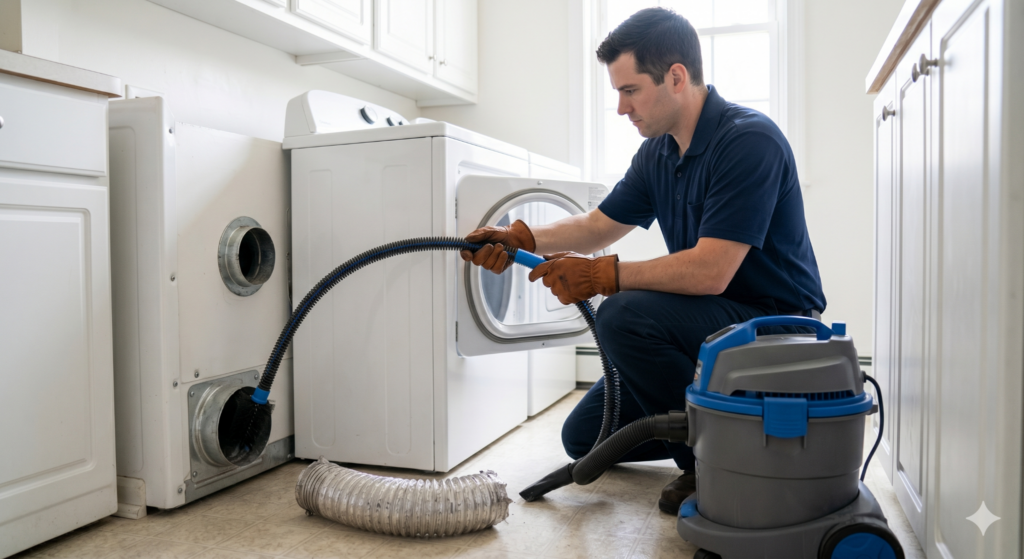
A thorough professional cleaning goes well beyond what a homeowner can accomplish with a vacuum and a brush kit purchased at a hardware store.
A technician will start by disconnecting the dryer and inspecting the full length of the duct run, not just the section behind the appliance. Rotary brush systems and high-powered vacuums are used to dislodge and extract lint from the entire duct, including any bends or transitions. The exterior vent cap is inspected for proper operation and checked for bird nests, debris, or damage that would restrict airflow.
The technician will also evaluate the duct material itself. If flexible plastic ductwork is present, replacement with rigid or semi-rigid metal duct is strongly advised. Rigid metal provides smooth interior walls that resist lint accumulation and are far less likely to collapse or kink, both of which are fire risks.
After cleaning, the technician will run a test cycle to confirm that airflow has been restored and that the exterior cap is opening and closing as it should.

The Fire Risk in Plain Numbers
The U.S. Fire Administration reports that dryer fires cause an estimated 2,900 residential structure fires annually, resulting in 5 deaths, 100 injuries, and $35 million in property damage each year. Failure to clean the dryer vent is cited as the leading contributing factor.
What makes this particularly alarming is that lint ignition is not a slow, smoldering event. Lint is one of the most combustible household materials. Once ignited inside a duct, a dryer fire can spread rapidly through wall cavities and into adjacent living spaces with very little warning time.
Dryer vent fires are preventable. They require no special equipment, no major renovation, and no significant disruption to the household. A once-yearly cleaning appointment is the primary line of defense.
Frequently Asked Questions
How do I know if my dryer vent is clogged?
The most common indicators are longer drying times, a hot dryer exterior, a burning smell during operation, and excessive humidity in the laundry room. If the exterior vent flap does not open while the dryer is running, the vent is likely blocked.
Can I clean my dryer vent myself?
Homeowners can clean the short section of flex hose directly behind the dryer. However, the full duct run, particularly in longer or multi-bend installations, requires rotary brush equipment and a commercial vacuum that most homeowners do not have. DIY cleaning of just the accessible section leaves the majority of lint accumulation unaddressed.
How long does a professional dryer vent cleaning take?
Most residential dryer vent cleanings take between 45 minutes and 90 minutes, depending on the length and configuration of the vent run.
Will cleaning my dryer vent reduce my energy bills?
Yes. A restricted vent forces the dryer to run longer to accomplish the same drying result. Restoring proper airflow typically reduces drying time per load, which translates directly into reduced energy consumption over the course of a year.
Is dryer vent cleaning covered by homeowner’s insurance?
Preventive maintenance like dryer vent cleaning is generally not covered by homeowner’s insurance. However, some insurers require documentation of maintenance to process claims related to dryer fires, making professional cleaning records valuable.
How is dryer vent cleaning different from cleaning the lint trap?
The lint trap catches large lint particles before they enter the duct. Smaller particles pass through and accumulate along the full length of the vent run. Cleaning the lint trap after every load is important, but it does not substitute for periodic cleaning of the duct itself.
My dryer is only a few years old. Do I still need to clean the vent?
Yes. The age of the appliance has no bearing on how quickly lint accumulates in the vent. A new dryer connected to a long or poorly configured duct will develop buildup at the same rate as an older unit.
Contact Grapids Home Services
If your dryer is taking longer to dry, the laundry room feels warmer than it should, or you simply cannot remember the last time the vent was inspected, now is the right time to schedule service. Contact us online or call Grapids Home Services at (616) 210-3456 to schedule a dryer vent cleaning appointment for your West Michigan home.
About Grapids Home Services
Grapids Home Services serves homeowners throughout West Michigan with HVAC, plumbing, and indoor air quality solutions. From Grand Rapids to the surrounding communities, the team is equipped to handle routine maintenance and urgent repairs with the same level of care and professionalism. When your home needs expert attention, Grapids Home Services is ready.